Micro markets

Micro Markets: An Open, Self-Checkout Store Inside Your Building

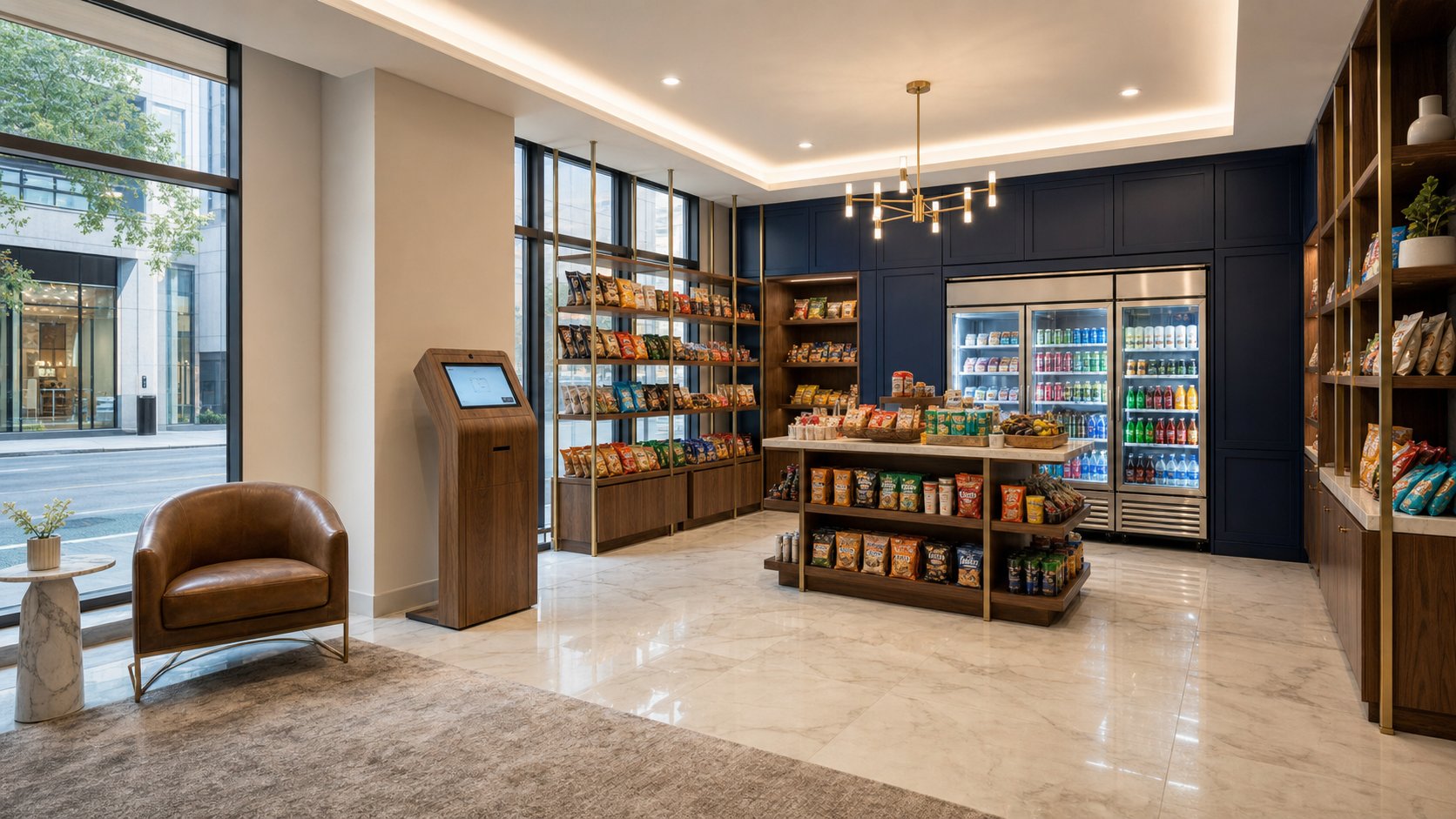
A micro market replaces a row of machines with an open shelf-and-cooler layout and a self-checkout kiosk. People can pick up products, read labels, and buy more per visit — and VendAI runs the whole thing.

Micro market with open shelving, coolers, and a self-checkout kiosk

What you get

01

Far more selection

Open shelving and coolers hold many times what a machine can, including fresh meals, dairy, produce, and multi-serve items.

02

Products people can handle

Shoppers can read nutrition labels and compare items, which lifts basket size compared with vending.

03

Self-checkout kiosk

Tap, card, or phone at the kiosk. No attendant, no cash, no line at a counter.

04

Looks like a real store

Branded fixtures, clean lighting, and a tidy layout that upgrades the space instead of cluttering it.

05

Managed end to end

VendAI handles the buildout, stocking, rotation, expiry checks, cleaning, and support.

06

Zero cost to the site

You supply roughly 100–400 sq ft, power, and traffic. We supply everything else.

Is your site a fit for a micro market?

  • Generally works best with 75+ people on site daily, or steady resident and guest traffic in a building.
  • Needs a semi-contained space — a break room, amenity room, or lobby alcove with light supervision.
  • Requires standard power for coolers and freezers, plus a network connection for the kiosk.
  • Smaller sites are usually better served by a smart store or smart cabinet, which we will tell you honestly.
  • Product assortment is reviewed regularly against actual sales, not left static.

Best fit

  • Offices with 75+ staff on site
  • Warehouses and plants with multiple shifts
  • Large residential and hospitality properties
  • Campuses and training centres

A free site assessment tells you whether a micro market or a smaller smart store makes more sense for your square footage and traffic.

Book a Free Site Assessment

What a micro market actually requires

Space and layout, in real numbers

A workable compact market is about 100 to 150 square feet: two glass-door coolers, one freezer, an eight to twelve foot shelving run, a kiosk stand, and enough clear floor for two people to pass. Between 150 and 300 square feet you gain a second cooler bank, dedicated fresh-meal shelving, and space for a coffee station. Above 300 square feet the room starts behaving like a small convenience store, which is where multi-shift plants and large offices end up. The constraint is rarely total area — it is usable wall length, because coolers must sit against a wall on their own circuits.

Power, network, and the two things that delay installs

Each cooler and freezer should have its own standard 15-amp circuit; sharing one circuit across three units is the single most common reason an install has to be resized. The kiosk needs an outlet and a stable connection — wired is better, but good Wi-Fi coverage works. The other frequent delay is access: a freight elevator that cannot take a cooler on a pallet, or a loading route through an active work area. We check circuits and delivery path on the site visit, before anything is ordered.

Assortment: what a market carries that a machine cannot

The range is what justifies the room. Typical planograms run 150 to 400 items: sandwiches, wraps, salads, bowls and hot-hold entrees; yogurt, cheese, eggs and fruit; full-size and multi-serve snacks; energy drinks, cold brew, sparkling water and juice; plus non-food basics like pain relief and phone cables in industrial settings. Fresh items are the reason people come back daily, and they are also the reason headcount matters — fresh has to turn, or it gets pulled.

Shrink, cameras, and how the honesty question really plays out

Every property manager asks about theft. In practice, shrink in a managed unattended market typically sits in the low single digits as a share of sales, and it is our exposure rather than yours. Camera coverage, kiosk transaction records, and per-site shrink tracking keep it visible. When a site trends badly, the fix is usually structural — reposition high-value items, move the entrance line of sight, or convert to a closed smart store where payment is authorized before the door opens.

Service cadence and who touches what

A market is not a machine you fill once a week and forget. Our route staff restock, rotate, pull short-dated product, log cooler temperatures, wipe fixtures, and clear the kiosk area on every visit, and remote sales data sets the frequency — commonly twice a week, more during plant turnarounds or busy seasons. Your team never handles product, cash, dates, or refunds; support requests come to VendAI directly.

If you are still weighing formats, these comparisons cover the tradeoffs in detail: micro market vs. vending machine, glass-front smart stores, and what vending costs an Edmonton property.

Worked example

A 180-person Edmonton distribution site

Two shifts, a lunchroom off the warehouse floor, roughly 220 square feet available, and nothing open within driving distance at 5 a.m.

  • Three glass-door coolers, one freezer, a twelve-foot shelving run, and one self-checkout kiosk
  • Around 280 items, weighted to entrees, sandwiches, high-protein snacks, energy drinks, and coffee
  • Coolers on dedicated circuits; kiosk on wired network in the lunchroom
  • Restocked twice weekly, with remote monitoring on the twenty fastest movers
  • Equipment, buildout, stocking, cleaning, repairs, and refunds all carried by VendAI

Micro market questions

The practical questions that come up before approval.

How much space does a micro market need?
Plan on roughly 100 to 400 square feet. A compact layout is about 100 to 150 square feet with two coolers, one freezer, a shelving run, and a kiosk. Above 300 square feet you can add a second cooler bank, a coffee station, and wider seating flow.
What power and network does it require?
Each cooler or freezer wants its own standard 15-amp circuit, and the checkout kiosk needs an outlet plus either wired internet or reliable Wi-Fi. If the room only has one shared circuit, we either add capacity with your electrician or scale the equipment down to what the room can carry.
How many people does a micro market need to work?
Around 75 or more people on site daily, or steady all-day resident and guest traffic in a building. Below that, fresh product turns too slowly and a glass-front smart store performs better per square foot.
Is theft a problem in an unattended market?
Shrink exists but is manageable and it is our risk, not yours. Cameras cover the space, the kiosk records every transaction, and we track shrink against sales by site. If it climbs, we adjust the layout, the assortment, or move to a closed smart store format.
Who handles expiry and food safety?
VendAI does. Our route staff rotate stock on every visit, pull anything approaching its date, log cooler temperatures, and clean the fixtures. Nothing about date checking or food handling falls to your team.

Free report

Request a Free Site Assessment

We’ll review your current vending or snack setup and deliver a simple one-page Smart Break Room Report:

  • Suggested vending machine, smart cabinet, smart store, or micro market based on traffic, space, visibility, and the audience using the area.
  • Recommended product mix (including healthy options) tailored by industry.
  • Suggested machine setup and placement for maximum usage.
  • Implementation plan and timeline if you decide to move forward.

No obligation, no pushy sales – just clear numbers and a plan so you know what smart vending can do for your workplace.

Get started

Ready to Modernize Your Vending?

Tell us about your property or workplace and we’ll map out a premium smart-store program that fits the space.